
Case Study
•Designing a Hybrid Database Architecture for a Social Platform
Designing a Hybrid Database Architecture for a Social Platform
Designing and implementing a hybrid database architecture using Neo4j and PostgreSQL to model complex social relationships efficiently while keeping transactional workloads simple and reliable.
Context & Problem
I joined Gamerstag as the sole backend engineer to build the backend for an esports social platform that included user profiles, follow relationships, posts, threaded comments, and tournament participation. From the beginning, the product’s core experience revolved around how users were connected to each other rather than simple data storage.
While building the backend, I initially considered PostgreSQL as the primary database. This worked well for basic operations, but as I started thinking through realistic worst-case scenarios, the cracks began to show.
Imagine thousands of users actively following thousands of other users. In a relational model, this results in a massive join table representing follow relationships. Even at moderate scale, this table can grow to tens or hundreds of millions of rows.
Now consider a seemingly simple but core product query: “Show me the followers of this one user.” In SQL, this means querying a very large table where that single user’s relationships are buried among millions of rows. Indexes help, but the complexity becomes much more apparent as soon as the product asks richer questions.
For example:
- Find mutual followers between two users
- Fetch a post with all nested comments and replies (up to two levels deep)
- Show tournaments joined by people I follow
- Fetch comments where my friends have replied
These queries are not edge cases—they are central to the product. In a purely relational setup, answering them requires multiple joins, self-joins, or recursive queries on high-cardinality tables. As features grow, query logic becomes harder to reason about, optimizations become fragile, and small schema changes risk breaking multiple parts of the system.
At this point, the concern was not whether PostgreSQL could handle the data volume—it can—but whether the system would remain maintainable and evolvable as relationship complexity increased. This was a strong signal that the data model itself was misaligned with how the product naturally thinks about data.
Architecture
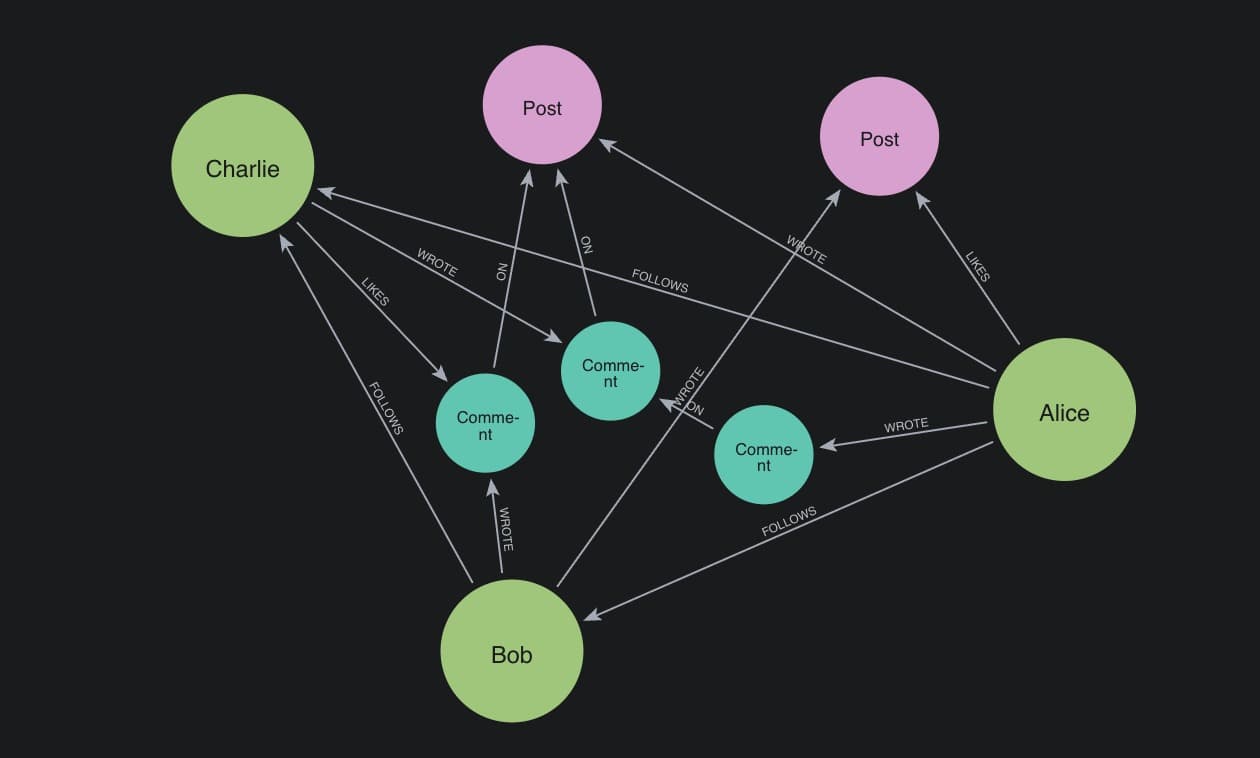
Core social graph modeling users, posts, comments, and relationships as first-class nodes. This structure enables efficient traversal for follows, likes, threaded discussions, and social discovery queries that are difficult to express cleanly in a purely relational model.
Key Engineering Decisions
Proposing a Hybrid Database Architecture
After researching how large-scale social platforms model relationship-heavy data, I proposed a hybrid database approach. The idea was to use a graph database for core social relationships while retaining a relational database for transactional workloads. Although the founder was initially skeptical, the approach was approved after reviewing the long-term trade-offs and scalability concerns.
Using Neo4j for Relationship-Heavy Data
Neo4j was chosen as the primary database to model users, follows, posts, comments, replies, and tournament participation as nodes and edges. This allowed relationship-based queries to be expressed as graph traversals, closely matching the way the product reasoned about connections between entities.
Retaining PostgreSQL for Transactional Data
PostgreSQL was retained as a standalone database for chats, notifications, and other transactional data. Data ownership between databases was kept strict, with no duplication across systems to avoid inconsistency and synchronization issues.
Adapting to the Graph Paradigm
Because Neo4j lacked a mature ORM at the time, I built a lightweight abstraction layer using Joi for validation and reusable repository functions. This required a paradigm shift—from SQL-style querying to graph traversal—but resulted in clearer and more expressive data access patterns once established.
Trade-offs & Constraints
The hybrid approach introduced operational complexity by requiring two databases to be deployed and maintained. There was also a learning curve associated with graph modeling and traversal-based querying, as well as the need to build internal abstractions due to the lack of a mature ORM. These trade-offs were accepted because relational joins did not align well with the application’s core access patterns.
Business Impact
Relationship-heavy queries became easier to express and reason about when modeled as graph traversals instead of complex joins
Clear data ownership and graph-based modeling reduced cognitive load and made the system easier to evolve safely
The backend was designed with tens of thousands to hundreds of thousands of users in mind, avoiding early architectural dead-ends
What I'd improve at 10× scale
At significantly larger scale, I would consider introducing read replicas or graph sharding strategies for Neo4j, along with stronger tooling around migrations and backups. I would also evaluate newer graph tooling or managed offerings to reduce operational overhead while preserving traversal performance.